
darc awards voting has begun!
(Worldwide) - An international panel of independent lighting designers have chosen their shortlists for each of the project categories. Public voting by independent lighting design community has now begun.
The project shortlists have now been chosen by the international lighting design judging panel for the darc awards and voting by the international lighting design and light art community has begun.
The shortlists can be viewed here... www.darcawards.com/view-entries
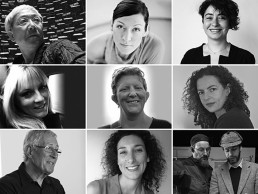
The panel consists of Kaoru Mende (Japan), principal of Light Planners Associates; Karolina Zielinska-Dabkowska (Poland), a lighting architect and researcher; Chiara Carucci (Italy), Lead Coordinator of Light-Related Organizations for the International Year of Light 2015; Emma Cogswell (UK), Projects Manager for the IALD; Liz Peck (UK), President of the Society of Light and Lighting; Lara Elbez (Spain), lighting designer; Christopher 'Kit' Cuttle (New Zealand), lighting designer, author and academic; Naama Steigman (Israel), a partner at Studio Twilight; and musson+retallick (UK), artists who regularly use the medium of light in their work.
Out of the 450 entries for the darc awards, twelve from each project category have been chosen by the judging panel for lighting designers and light artists to vote on.
Product categories go straight to the public vote so that lighting designers can genuinely vote for their favourite products from the last three years.
Votes are now being cast on the darc awards website, www.darcawards.com, from until August 17th with the awards event, darc night, taking place in London on September 24th during London Design Festival.
All independent lighting designers that vote will be able to attend darc night free of charge on a first come first served basis (suppliers will be subject to a charge) turning the traditional awards ceremony protocol on its head. The awards evening itself will be completely different with free streetfood and drinks all night, lighting installations by lighting designers who have teamed up with the manufacturer partners, and a completely different format for presenting the evening.
Manufacturer partners are Concord (who are teaming up with Speirs + Major); Cooledge (Light Bureau); Griven (Paul Nulty Lighting Design); Innermost (Elektra); KKDC (dpa); L&L Luce&Light (LDI); LSE Lighting (Troup Bywaters + Anders); Lucent (Michael Grubb Studio); Lumino (Electrolight); Megaman (Design In progress); Reggiani (BDP); and Zumtobel (Arup). Technical partner is XL Video and the event is part of the the International Year of Light 2015 programme.

CLS moves HQ
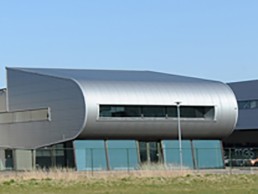
(Netherlands) - New location in Bijsterhuizen, Wijchen boasts 3000m2 of storage and production space and more than 1000m2 of office space.
Due to growth that CLS LED has experienced, the current building does not meet the requirements to produce professional LED lighting fixtures on a large scale. After a long period of searching for a suitable venue, it has found a new location.
The architecture of the building is suited to CLS, as the combination of design and functionality reflects its fixtures.
The location has 3000m2 for storage and production space and more than 1000m2 of office space. CLS continues with its ethos: 'Designed and Made in The Netherlands'. A unique selling point that makes a difference to fast deliveries at a very affordable price. Hence this rehousing was a logical step in continuing to meet growing demand.
The production space is set up on a large scale and equipped professionally. Because of this, with the current growth, CLS plans to meet the objective of producing every order, in any configuration, within two weeks.
As of July 22nd 2015 CLS will start working from the new address.
The new address details are:
CLS LED BV
Bijsterhuizen 2523
6604 LM Wijchen
The Netherlands
Tel: + 31 (0) 26 326 36 76
Fax: +31 (0) 26 326 36 77
8point3 appoints new technical sales consultant
(UK) - Gary Mills brings 30 years electrical and systems engineering experience to grow 8point3's lighting business.
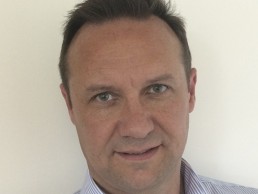
8point3, provider of energy saving LED solutions to customers across the private and public sector, has announced the appointment of Gary Mills as technical sales consultant.
Mills brings over 30 years of experience in electrical and systems engineering in the Ministry of Defence and computing and energy management industries. Using his background in electronics, optical quality, systems engineering, data-capture and energy management, Mills will be helping 8point3 grow its lighting business.
He commented: "Working within 8point3 I will be helping to develop still further lighting as a technology and network for a complete data-capture system, providing data from the site for the client to use for building efficiencies and business improvement."
Sharp Devices Europe relaunches microsite
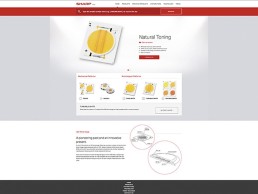
(Germany) - SDE redesigns www.sharpleds.eu to include expanded search function and address increasing significance of LED market.
Sharp Devices Europe (SDE) has completely redesigned its microsite www.sharpleds.eu. The website's many features include a clear overview of all available product types on a single page, an expanded search function, and a broad range of download options. By relaunching the website, LED pioneer Sharp lends credence to the increasing significance of the LED market.
As one of the pioneers in LED technology, Sharp established a series of industry benchmarks beginning with the mass production of LEDs in 1972. Sharp's invention of the multi-chip ZENIGATA LED in 2007 redefined standards.
With its relaunch of the website www.sharpleds.eu, Sharp Devices Europe makes it easier and more user-friendly to search for information about the Sharp LED line-up and LED products. The latest products, such as Natural Toning and INTERMO Module, are presented immediately on the start page. The user gets an instant overview of corresponding areas of application and technologies. The ‘Products' menu displays all of the available product lines. By selecting individual components, the user is guided to product-specific details that can be downloaded with a single click, just like user instructions or optical .ray files. Alternatives within the same product class are also recommended.
The new search functions guide the user directly to LED products. These functions allow for the entry of a serial number or selection based on area of application, technology, or performance features such as number of lumens. SDE also set up the ‘Previous Products' menu to make sure that users still have access to older product generations. All of the corresponding data sheets and assembly documents are available there. Distributors within the EU can be selected using a country-specific interface.
The new website's finishing touch is its press area, which offers press releases specific to LED topics, as well as other announcements. SDE Communication Manager Christian Hansen said: "Sharp focuses on LED technology because it is the most efficient and long-lasting source of light in the world. We are delighted that our new site at www.sharpleds.eu lives up to such great expectations. The website features a clear overview of all available types of products, a targeted search function, and a broad range of download options. This makes the microsite as efficient as an LED itself."
ETC mourns passing of Fulvio Cotogni
(USA) - ETC's regional manager for Southern Europe and Middle East passes away after courageous battle with cancer.
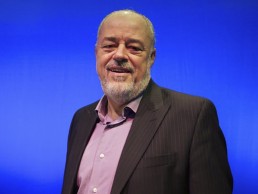
One of the industry's brightest lights dimmed on Thursday, when Fulvio Cotogni, ETC's regional manager for Southern Europe and the Middle East, passed away after a courageous battle with cancer.
A funeral for Cotogni was held on Saturday, where friends and family had the opportunity to share memories of him. ETC CEO Fred Foster gave a eulogy in which he said: "I am incredibly honoured to have known Fulvio for a couple of decades, and to have been his colleague for much of that time. My wife, Susan, refers to Fulvio as an ‘ancient soul', not because he was old, but because he had the wisdom and patience of the ages. It was in his eyes, it was in his rich voice and in his wry smile. Fulvio has taught us all more than we even realise."
Cotogni was known for his immense personality, sense of humour and infectious laugh. He began his career in lighting when he was 25 years old, joining Rome-based broadcast lighting company Quartzcolor Ianiro as a salesman, where he stayed for eleven years.
In 1985, Fulvio and his wife, Assunta, founded Arri Italia. The company grew quickly under their direction, and they began selling the very first ETC controls, branded as Arri lighting products. Arri Italia eventually became one of the top broadcast lighting firms to gain a major foothold in the entertainment lighting market. Eventually Fulvio left Arri Italia and returned to Quartzcolor - which was under the Strand umbrella by then - where he worked for four years, ultimately becoming the general manager for the Italian market.
Fulvio then made the decision to work with longtime friend Mario De Sisti. In that job, he was responsible for promoting ETC products in Italy. Just a couple of years later, in 1999, he officially joined ETC, overseeing the opening of the company's Rome office. In his role as regional manager, he ran ETC Italy, and grew the sales territory in Southern Europe and the Middle East.
"Fulvio was a very dear friend," says ETC Vice President of Sales Mark Vassallo. "He was one of the best salesmen I've ever worked with, and he cannot be replaced. Our hearts and thoughts go out to Assunta and [their son] Valerio. He will be missed and there will be a hole in our hearts from his passing."
Acolyte opens new Australia office
(Australia) - Acolyte increases global reach by adding David Virgona to team as Australian National Sales & Technical Manager.
Acolyte LED has increased its global reach by adding David Virgona to its growing team. As the Australian National Sales & Technical Manager, Virgona will be covering the markets of Australia and New Zealand.
Virgona was born in Sydney, Australia, and has a diverse background that includes more than fifteen years of lighting experience. After an early stint as a police officer for the NSW Police Force, he worked for Legrand Australia and then Thomas & Betts as a sales manager for the emergency lighting division.
He moved on to Gerard Lighting to reinvigorate their emergency lighting section. Within a seven-year period, he more than tripled their gross annual sales, re-engineered their product line to utilise LED technology, and introduced Lithium Ion batteries to the mix. He also incorporated DALI control & sensor technology to keep up with market trends and customer demands.
Virgona's more than fifteen years of experience also includes mechanical engineering, wireless communications, lighting product design, LED product design, Lithium Ion battery design & structuring, and emergency lighting.
Romare Bearden Park, USA
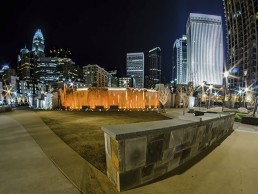
Opened in the summer of 2013, Romare Bearden Park in Charlotte, North Carolina was created to enrich the lives of the community, providing opportunities for intellectual, social and physical well-being.
Envisioned to grow into an established landmark and destination, it provides space for urban recreation and gathering in the heart of Charlotte’s city centre. The $11m space commemorates the life and artistic achievements of internationally regarded black artist, Romare Bearden - born in a long-gone house at Martin Luther King Jr. Boulevard and Graham Street, Charlotte in the early 1900’s near to where his namesake park is located today. Bearden became an internationally known creator of original oil and watercolour paintings, drawings and abstract art collages, up until his death in 1988. Although Bearden moved north as a child, some of his art depicts Charlotte’s early 20th Century African-American community.
Located near the entrance of Charlotte’s new Triple A baseball stadium, the park is actively enjoyed by many who visit this newly popular city setting. Boasting 5.4-acres, the park covers an entire square city block, formerly home to a city bus parking lot. It was designed with several distinct areas, each inspired by facets of Bearden's life and his career-wide acclaim that grew steadily over decades. In creating Romare Bearden Park, its design was awarded to the landscape architecture company LandDesign, who has offices in Charlotte, NC amongst others and artist Norie Sato. LandDesign followed its corporate philosophical underpinnings of honouring the land and allowing it to accommodate a vision for a special place. Its sensitivity to location ensured people and land were brought together in a manner that provided a powerful, encompassing personal experience.
LandDesign’s master plan for the park evokes Romare Bearden and his artistic use of his own memory, for what he termed 'triggers' for key inspirational points when he was designing and executing his artworks. The influence of Bearden resulted in an eclectic mix of urban park elements that include two adjacent multi-acre gardens and greens with adjoining courtyards. Moveable in-park tables and chairs evoke thoughts of Paris, where Bearden travelled to and lived for one year. Courtyards are shaded by substantial natural, indigenous canopies of trees throughout the park, and on park sides of adjoining city streets.
A large formal event common, known as Big Moon Green, transitions into an open area for informal children’s activities, as well as for structured events for people of all ages. Gardens named Madeline’s and Maudell’s, recall previously articulated memories by Bearden of gardens his mother and grandmother had, that inspired several of his artworks. The park also has interactive digital chimes and waterfalls.
Working alongside LandDesign was architectural lighting designer Randy Burkett, founder and principal of Randy Burkett Lighting Design, headquartered in St. Louis. Burkett and LandDesign agreed that lighting for Romare Bearden Park should subtly serve as a complement to Bearden’s lifelong artistic sensibilities, and his evolved appreciation for lasting good design in the creative, artistic sense. Built upon this strong visual imagery, the lighting design further exploited the metaphors into the night.
Ordinary pole-mounted street lighting would simply not do. With this in mind, Burkett selected Hess America Fiora and Riva pole-mounted luminaires on inverted tapered poles, which distinctively light main pathways and an interactive play area in the park.
One main pathway, known as The Evocative Spine, runs diagonally through the site, allowing visitors to see and experience individual park vignettes as they walk. Fiora, a striking feature pole from Hess using light reflected from a faceted disk, is used along the Spine’s edges to clearly define the pathway when seen from the far reaches of the site. These luminaires are primary components of the park, integral to its overall design and function.
On the whole, the lighting played an important role in establishing visual hierarchy and scale for the park’s pedestrian pathways. Along many walkways, conventional pole and bollard path-lighting techniques are eschewed for those emphasising reflected illumination from surrounding vertical surfaces.
This approach provides soft, welcoming facial light while helping to fortify visitor orientation and enhance wayfinding. This lighting of walls, landscape and art became a toolbox of sorts, used extensively throughout the project.
Visible from numerous high-rise residential, hospitality and office towers nearby, the park’s individual experience zones are articulated after dark using variations in light intensity, boundary light reinforcement, source colour and subtle dynamics. Views of the park grounds from the surrounding elevated structures bring to mind the artist’s passion for collages.
Water features are cast in an important role in visually animating space. Nighttime enlivenment comes from colour, generated by submerged LED RGB sources. More subtle light effects, however, reinforce the park’s underlying messages, like the stone niches seen through a waterfall’s veil revealed by light, suggestive of a distant and hazy memory. A dispersion of low-level pathway lighting forms an organic arrangement of circular LED wafers embedded within the paving material, symbolising the ever-changing journey along life’s path.
Pronounced shadows are revealed throughout the gardens by well-positioned precision accent light clusters mounted to poles. Lighting has helped create an authentic urban experience that celebrates Charlotte’s history and culture. Both orientation and wayfinding are reinforced by insightful arrangements of lighting equipment, with respect to the various activity nodes.
The park’s design memorialises Romare Bearden, through thoughtful use of architectural lighting, inviting people to walk through and enjoy the venue’s design and amenities.
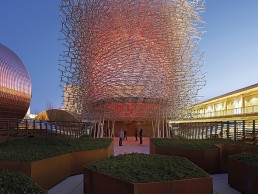
UK Pavilion, World Expo, Italy
The UK Pavilion highlights the decline of the world’s bee population and the importance of pollination for food production, looking at how new UK research and technology are helping to address challenges such as food security and biodiversity. Designed by an all British team - Nottingham-based artist Wolfgang Buttress with engineering from Simmonds Studio and the Manchester office of BDP who's lighting team, consisting of Rhiannon West, Chris Lowe and Colin Ball, provided the lighting design - the pavilion is an homage to the ground-breaking UK technology developed by physicist and bee expert Dr. Martin Bencsik.
The bees’ activities are monitored from the roof of Nottingham Trent University by Bencsik using accelerometers to detect and translate the vibrations made by bees as they communicate with one another. Visitors meander through an orchard, discover a meadow of wild flowers and enter the Hive, which pulses, buzzes and glows according to live-streamed signals from a real beehive in the UK. The accelerometers are used to measure the activity of the colony and algorithms are used to convert the bee colony vibrations into lighting effects. The concept, designed by Wolfgang Buttress, consists of 1,000 individually-addressable bespoke RGBW LED pixels (custom-made and integrated into the Hive engineered by UK manufacturer Stage One) allowing the Hive to pulse and glow, acting as a visual representation of bee activity.
Rhiannon West commented: “Our lighting vision from the start was integration of lighting within the landscape and architecture. We wanted to be seamless right from day one. We wanted light only where it was required; maintaining incredibly low levels of light whilst ensuring sufficient light is available to all required tasks.”
BDP needed to keep in mind low viewing angles and glare. The journey from beginning to end was intended to replicate a ‘waggle dance’ - a movement bees make to signal the direction of pollen to one another. This route by night comes alive with glowing pathways being the only source of lighting. Following the light takes you on a journey to the pavilion’s main attraction, the Hive.”
Due to the low levels of light in the centre of the Hive, BDP took care to reduce ambient light levels and minimise glare. This is achieved through luminaires integrated within details, ensuring that visitors’ eyes adapt as soon as they arrive. The Pavilion has various functions and the lighting design ensures that the systems for the bar, dining and conference spaces, together with the wayfinding and emergency lighting, integrate seamlessly into Buttress’s vision whilst maintaining incredibly low levels of light. Entering the Pavilion, the orchard’s pathways glow gently leading to the meadow where a series of trees are uplit and visitors are guided past a busy ‘swarm wall’ emanating a slight sparkle.
Visitors move around the meadow pathways in the formation of the ‘waggle dance’ all lit from a low level skirting detail. Over 600m of British company Lumenal’s Mira 7mm deep aluminium profile, integrated with iGuzzini LED, is used at ankle level around the honeycomb shaped walkways, the bar areas and into handrails to give a warm, honey like-glow. Below the hive deep recessed, low glare adjustable spotlights from Light Projects (also from the UK) provide pools of light to aid the reading of brochures and offsetting the drama of the animated Hive overhead.
Inside the heart of the building lies a decorative beehive-inspired lighting installation. This is a show space for fine dining, conference and government hosting, and the installation offers a variety of flexible lighting for each. An array of hexagonal aluminium extrusions from Scottish manufacturer (still part of the UK, just!), Mike Stoane Lighting (MSL), are scattered in small clusters over the ceiling, each providing a warm white glow with a slight sparkle using 2200K Cree chips.
Dave Hollingsbee, Mike Stoane Lighting's Managing Director, was clearly buzzing about the project: “We were delighted to be approached by BDP to help with the lighting of the inner hub. The brief was relatively flexible and open to suggestion, providing the result was very rich and warm and in the vein of a honeycomb.”
West is extremely happy with how the project panned out: “We developed a great working relationship with Wolfgang and this was fundamental to the success of the scheme. I enjoy focusing on the unique relationship between light and architecture, especially developing ideas where the atmosphere and experience of space become more important than the materials. This is a perfect example of that.”
The UK Pavilion is intended to be an exemplar of British design quality and ingenuity. It's all-British cast has blazed a trail at the Milan Expo with many critics lauding the pavilion as the most creative concept on site. And all done on time too. It makes one proud to be British!
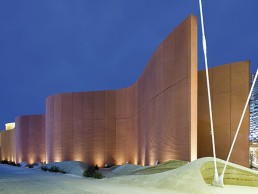
UAE Pavilion, World Expo, Italy
Bringing the planning principles of the traditional desert city to Milan, the UAE pavilion’s interior of self-shaded streets evokes the experience of the the country’s ancient communities, while demonstrating the natural energy efficiency of their compact urban form. Foster + Partners and Land Design Studio (Visitor Experience Designers) required a varying lighting design approach which had to cover several different disciplines from architectural and landscape to theatrical lighting. With extensive experience in theatre and architectural lighting DALD helped create a sympathetic synergy between the architecture and the visitor experience.
The pavilion occupies a large site close to the centre of the Expo and is accessed via its main circulation axis, the Decumanus. From here, visitors are drawn into the mouth of a canyon-like ramp space, defined by two undulating 12-metre-high (GRC) walls. The high walls continue through the 140-metre site in a series of parallel waves, unifying the visitor spaces within a dynamic formal language designed to convey the ridges and texture of sand dunes.
After extensive lighting trials with samples of the GRC wall material, adjustable buried lighting fixtures fitted with 2,700K LED, light straw filters and spreader lenses were chosen to up light the walls, which subtly create soft warm brush strokes of light across the undulating surface complementing the wall pigment. Within the central ramp, as a part of the visitor experience, dynamic interactive displays housed within cubes are supported by glass fins which feature a dot manifestation, which is edge illuminated, creating an interesting ethereal contrast between the spine of the ramp and the walls.
As the ramp weaves a path, small custom designed buried fixtures fitted with a 2,700K LED and diffusion film up light the walls at the pinch points, effectively creating an interesting perspective vista at night through the canyon-like space. At the top of the ramp a large drum houses a state-of-the-art auditorium and interactive post show space.
The external lighting of the drum plays an important part in creating a dramatic focal point to the pavilion. Extensive lighting trials took place in Italy with Foster + Partners to establish what cladding material and light source should be used for the exterior of the drum – a Gold Tecu material was chosen along with a high output linear LED strip fitted with an amber filter. The LED strips are positioned at the top of the drum, which uniformly graze the Tecu material, without creating any glare issues. The light in turn reflects off the drum and onto the surrounding GRC walls and perimeter staircase, creating an ambient depth. Within the drum is an auditorium, with a 360º perimeter screen. As the creative design team required the space to be more than just a cinema, but also an immersive experience. DALD chose to use a combination of automated LED wash lights and spots.
The automated lighting fixtures are positioned off a large circular truss, which allows for multiple lighting positions for illumination of the perimeter screens, suspended casement roof and the tiered audience seating block. The perimeter staircases are edge illuminated by custom lengths of LED strip set within an extrusion.
After the screening of the film, the visitors enter the post show space, which features a large holographic experience. As with the auditorium, automated lighting is used, which helps to add to the immersive quality of the space. On exiting the post show space the visitors move to the external ‘Oasis’ area, linking the first floor level with the ground floor. The ‘Oasis’ features desert flora planting as well as two large palm trees. By night the space is lit by a combination of sources, which includes the projection of dappled palm leaves and low level accent spots set behind planting, creating a sense of intimacy within the ‘Oasis’. Influenced by ancient planning principles, the pavilion’s interior evokes the narrow pedestrian streets and courtyards of the traditional desert city, and its contemporary reinterpretation in the sustainable Masdar masterplan.
The first floor level features an exhibition of cultural objects, discretely lit by small linear fittings recessed up between dark slatted ceilings that are almost invisible off axis and a detail which is used throughout the pavilion. A 3000K LED source was chosen to compliment the interior terracotta wall colour. All the curved staircases throughout the pavilion are illuminated by custom designed side emitting diffused LED strips set within the handrail, which when viewed from below appears homogenous.
An exhibition on the ground floor of the main drum celebrates Dubai as host city for the 2020 Expo and is lit by a selection of RGB and single colour LED fittings to graphics and design detail. Although the Pavilion is large the lighting design approach is minimalistic stretching the light sources to their maximum potential.
The UAE’s National Media Council assembled a world-class team to deliver an unforgettable pavilion experience, not only producing a building design that ‘wows’ visitors but also satisfies the requirement for the pavilion to be environmentally friendly. The use of LED technology is now a given but the pavilion goes several steps further. The design of the pavilion follows the principles of LEED with a combination of passive and active techniques. Most significantly, the building is designed to be recycled and rebuilt in the UAE after the Expo.
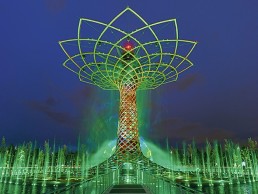
Tree of Life, World Expo, Italy
As part of Expo 2015 ACT lighting design was commissioned by Balich Worldwide Shows to create and develop the visual and lighting design of an iconic installation, Tree of Life - Albero della Vita. Designed by Marco Balich and Studio Gioforma, artistic director of the Italian Pavilion of Expo 2015, Balich was inspired by the drawing Michelangelo Buonarroti created for the piazza del Campidoglio in Rome. The structure was built by Orgoglio Brescia and Koert Vermeulen joined the creative team as Lighting Designer / Director of Mise-en-Scene.
The tree with it's vertical, symbolic gesture is both an Italian and international icon representing nature as a source of life, but also symbolising the many roots and metaphorical branches of the Italian excellence. This iconic structure symbolically offers its seeds and fruits to Italy and the entire world.
Placed in front of the Italian Pavilion, the monument was installed in the middle of Lake Arena, where visitors were immersed into breathtaking events. The Tree of Life interactive structure, with an inner skeleton made of steel and an outer cover in wood, is over 30-metres high and on top of the gigantic trunk stands a hat that simulates the intertwined branches of a tree, with a diameter of 45-metres.
Visitors were able to not only enjoy the spectacle from the exterior, but also had the chance to climb inside the structure to discover more surprises. For this monument, with its advanced technology, constantly illuminated with LED lights, Koert Vermeulen and ACT lighting design created an original visual scenography to produce genuine dynamic effects through a play of light, video, water, fireworks, as well as bubbles and sounds. The Tree of Life also changed as the hours went by, truly becoming the centre for many of the events in the Pavilion's extensive schedule.

Cooper brand goes to Eaton
(USA) - Cooper Lighting brand to be dropped in favour of Eaton's Lighting Division. Brand names acquired in acquisition including Halo, Metalux, Lumark, Corelite, Neo-Ray, Fifth Light and Greengate to remain.
Ever since Eaton Corp. acquired Cooper Industries in 2012, it has gradually been shifting the emphasis in its lighting branding from the Cooper name to Eaton. Now, Eaton has made it official with a statement from Mark Eubanks, president of Eaton's Lighting Division:
“In the nearly three years since Cooper became part of Eaton, a worldwide leader in power management, we have been gradually transitioning from the Cooper Lighting name to the Eaton brand. This month, as Eaton's Lighting Division, we take the next step in brand transition: going forward, we will refer to ourselves as Eaton.
“While this name for our business may feel new, customers will recognize the same commitment to innovation, reliability, customer service and market leadership that they have come to expect. Our valuable lighting and controls product line names, such as Halo, Metalux, Lumark, Corelite, Neo-Ray, Fifth Light, Greengate and more, will remain unchanged and will continue to lead advancement of new integrated lighting and controls technologies and solutions within our industry. Eaton is committed to being the most admired company in its all of its markets, including the lighting industry.
“Eaton is a recognized leader in the residential, commercial and industrial electrical markets, and we have grown over the past 100-plus years into a global power management company focused on helping customers manage power more reliably, efficiently, safely and sustainably. The company has expanded its expertise and portfolio of products by integrating the competencies of some of the most respected names in the electrical industry, including our well-respected lighting and controls portfolio. The scope and scale of our global business makes it most effective to speak to the market from a unified and consistent platform - the Eaton brand.
“While our name may have changed, our customers can rest assured that we have the same unwavering passion and commitment to provide innovative products and solutions our customers can rely on.”
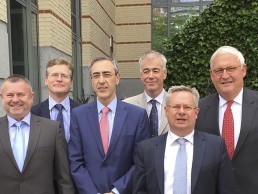
EucoLight arrives
(Belgium) - Brussels based association to focus on regulatory framework for lighting waste recycling.
A new European association focused on WEEE in the lighting sector has been established. EucoLight has been created to give a voice to WEEE compliance schemes that are specialised in managing the collection and recycling of lamps and luminaires.
The WEEE Directive, as recast, has greater impact on lighting than on any other industry sector. Despite being an individual product low in weight, there are a greater number of lamps collected and recycled in Europe than all other types of electrical equipment. Furthermore, unlike most other items of WEEE there is no value associated with waste lamps. Most lamps are also fragile and hazardous, making them difficult to transport, and requiring specialist recycling facilities.
Brussels based EucoLight has been established to respond positively to these challenges, and to engage effectively with other European bodies and trade associations. EucoLight will work to enhance the regulatory framework for lighting waste and associated level playing field, support the development of appropriate international standards, provide guidance and support to its members.
EucoLight membership is open to any non-profit WEEE compliance scheme fulfilling the Extended Producer Responsibility of lighting producers established in Europe. WEEE schemes from a total of sixteen different EU member states are members.
Mr Juan Carlos Enrique, the newly elected Chairman of the Board of Directors of EucoLight and Managing Director of AMBILAMP (Spain), said: "the creation of EucoLight is an important milestone for WEEE compliance schemes in Europe that focus on lamps and lighting who will now have a face and voice in Brussels. EucoLight will help to strengthen its members' activities and services around Europe, thus helping them to promote a better lighting products recycling service, aiming to an efficient circular economy."
Nigel Harvey, Chief Executive of Recolight, who has also been elected to the board of EucoLight said: “There are a number of changes to WEEE being considered at a European level. EucoLight will work to ensure that those changes are appropriate for the lighting industry. I am delighted to be on the board and to support the ongoing work of the lighting industry at a European level.”
In his tasks, he will be supported by Mr. Hervé Grimaud, Managing Director of Recyclum (France), as Vice Chairman; Mr. Béla Kovacs, Managing Director of Electro-coord (Hungary) and of Recolamp (Romania), as Treasurer; Mr. Nigel Harvey, Managing Director of Recolight (United Kingdom), as Secretary to the Board and Mr. Diederik de Stoppelaar, Secretary General of LightingEurope. LightingEurope is an affiliated member of EucoLight.
